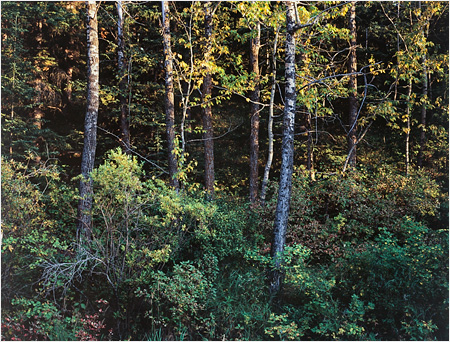
I took Tachihara Tim out for a spin this fall on a film outing with Darwin and Hiroaki Kobayashi. It was pretty sunny except for some shady parts along an east-facing cliff. The sun was low on the horizon creating some wonderful, golden light. I used Velvia slide film and made several exposures. We sent the film to Vancouver for processing, and then we took the slides to ABL Imaging Group in Calgary for scanning. In the end, I chose only two files to be scanned in because the cost of each scan was $30. As a comparison, we also photographed the slides on a light table with Darwin’s Canon EOS-1ds Mark III 21 megapixel camera to see what kind of quality we could achieve by ‘scanning’ in the images ourselves. Here are the photographs of the slides taken with the EOS-1ds Mark III. (The files were flat so a few adjustments have been applied to bring the photograph closer to the original contrast of the slide film).

And here are the scans from ABL. I haven’t done any processing on these files, just resized them for the blog and sharpened them the same way and amount as the two photographs above.
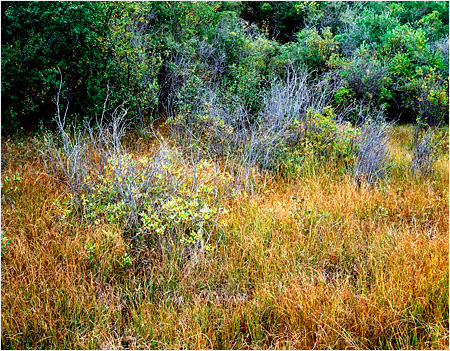

I don’t think your first thought when you get a product or service from someone should be, “WTF?” You’ll have to take my word that the photographs from Darwin’s camera are closer to the actual film images captured (albeit with less luminousity and resolution). ABL’s rendition are over-the-top in colour and over-sharpened. Here is a 100% crop comparison of the first set of images. ABL’s is first (this has not been sharpened; this is the level of detail on the scan given to me) and our ‘scan’ second.
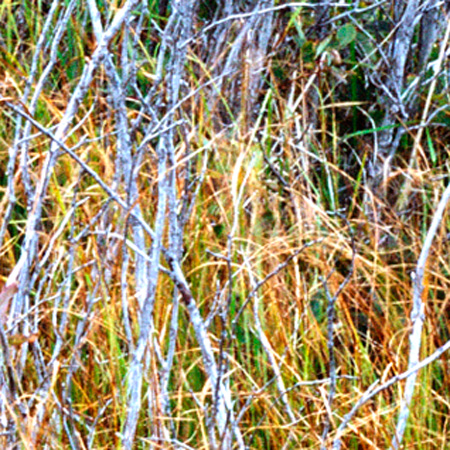

While they may look more punchy on the web, they are nothing close to what I captured. And ABL had the original slides to compare them to! The amount of sharpening it looks like has been applied by ABL means when I resize and resharpen, the image gets crunchy and crystalline, fast. While the crop of our ‘scan’ may look super soft, at least I can sharpen this image after resizing without losing quality. I don’t get it. If I’m paying $30 (each) for a faithful scan of my film, then that is what I would like back. Otherwise, what ‘expertise’ am I paying for? The real crapper is that hardly anyone is doing these kinds of scans anymore in Calgary so I’m kind of stuck. Oh well, at least a photograph of a slide can return a result just as good if not better — for cheaper!
So my question for you is…where do YOU scan your large format slide film so that the digital result is as close as possible ensuring you can make an amazing print?
Posted in Fabulous Film Fridays
Tags: fabulous film fridays, film, photography




 Sam's Rant
Recent Comments